

































Does a Cheaper Currency Counter Mean Lower Quality?
When selecting the best currency counter for your needs, pricing is a key factor. Currency counters range from a few hundred dollars to several thousand, and in this guide we break down the features that influence these price points without necessarily compromising on quality.

One Pocket vs. Two Pocket Counters
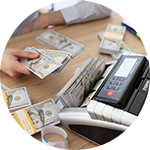
One of the most noticeable differences is whether a counter has one or two pockets. A one-pocket currency counter stops the count whenever a bill requires removal, which demands more operator intervention and usually results in a lower cost. Conversely, two-pocket counters divert rejected bills into a separate pocket, allowing them to continue counting uninterrupted—saving time and labor.
Value Bank Grade Counters
Value Bank Grade counters are designed for smaller cash batches and typically per and stacker capacities (around 200 notes), making them well-suited for moderate cash handling environments.
Bank Grade Counters
For businesses with larger volumes of cash, Bank Grade counters offer significantly higher capacity, counting up to 1,800 notes per minute. These models typically feature larger hoppers and stackers, which means they can process more notes without frequent reloading—ideal for high-cash environments where speed and efficiency are crucial.
Counterfeit Detection Features
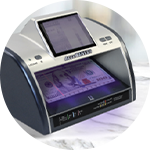
Advanced counterfeit detection is another factor impacting price. Models equipped with UV, MG, and IR detection technology offer reliable protection against counterfeit bills. Although these enhanced security features drive up the cost, they can potentially save your business from significant losses.
Brand Differences
Brand reputation also plays a significant role in pricing. Some manufacturers target high-volume environments such as banks and retail, while others focus on smaller businesses or personal use. At BankSupplies, we offer a wide range of reputable brands to meet every cash-handling need.
Currency Counter Comparison
The examples below illustrate how price differences are often tied to counting speed, capacity, counterfeit detection, and automation features rather than overall quality.
| Model | Category | Speed | Counterfeit Detection | Best For |
|---|---|---|---|---|
| Semacon S-1000 | Value Grade | 900 notes/min | None | Small businesses and low-volume cash handling |
| Semacon S-1200 Series | Bank Grade | Up to 1,600 notes/min | Optional UV/MG models | Banks, credit unions, and retail operations |
| Semacon S-1600 | Premium Bank Grade | Up to 1,800 notes/min | Advanced error detection | High-volume cash environments |
| AccuBANKER AB7100 ValuePro | Single-Pocket Discriminator | Up to 1,500 notes/min | Advanced counterfeit detection | Mixed denomination counting and value counting |
| Semacon S-2500 | Two-Pocket Discriminator | Up to 1,500 notes/min | UV, MG, IR & advanced sensors | Continuous counting with reject pocket automation |
Conclusion: Does Price Reflect Quality?
While a cheaper currency counter may have fewer features or lower capacity compared to premium models, this does not automatically mean lower quality. Matching the counter to your specific business needs is essential—affordable models may suffice for small to moderate cash handling, whereas high-volume operations may benefit from investing in a premium option.
Related Articles
Explore more resources from the BankSupplies Resource Center.

Can Your Currency Counter Detect Fake Money?
Learn about the counterfeit detection features in modern currency counters and how they safeguard your business.
Read Article
Does a Cheaper Currency Counter Mean Lower Quality?
Understanding price vs. performance in currency counters.
Read Article
Banks and Credit Unions Supplies List
Comprehensive catalog of essential supplies and equipment for banking operations.
View PDF