
































Counterfeit: Are you prepared?
Counterfeit currency is a reality — it’s in circulation. Accepting a fake note could lead to significant financial loss for your business. Protecting yourself is half the battle.
The Guy in the Basement
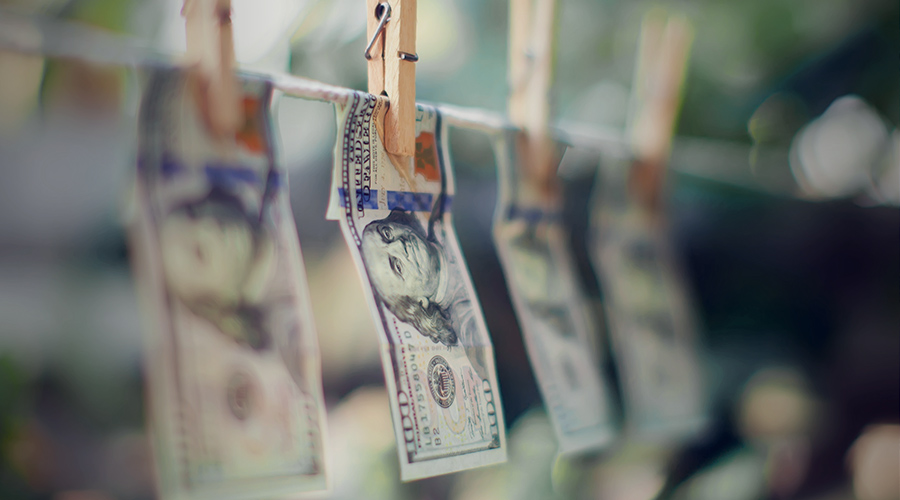
There’s a guy in the basement making counterfeit currency right now. He’s real. In fact, there are a lot of them. According to the Secret Service over $1,360,000,000,000 (that’s right; $1.36 TRILLION!) of all money in circulation worldwide is counterfeit.
Counterfeiters are always trying to stay one step ahead of the law, utilizing new technologies to produce counterfeit currency. Some of them have become very sophisticated at making the perfect note – to the extent that even experts cannot initially decipher between real and fake. Deciphering legitimate notes takes knowledge — understanding what to look for: positioning of elements, paper, watermarks, threads, and other key indicators. It’s the combination of these features that are most telling.
To the untrained eye most fake currency in circulation goes undetected. Money is such an integral part of our lives that it’s rarely looked at with scrutiny. That is, until you get stung.
The Secret Service is the government agency responsible for tracking down counterfeiters. According to recent statistics, the state of Florida averages $3.6 million a year in counterfeit apprehension; and that’s only what has been detected. Most recently, casinos in Michigan, Washington, California, Oklahoma, and Pennsylvania reported issues with counterfeit currency being taken in through their table games and teller windows. Many of which were not detected because they did not have adequate detection procedures in place to apprehend the counterfeit while on the premises.
This causes huge problems for businesses (large and small) that get stuck footing the bill. Often, it’s on a large scale because counterfeiters are savvy enough to recognize easy targets and common vulnerabilities by “casing the joint” ahead of time. In truth, most business establishments aren’t properly prepared to prevent counterfeit attacks. And the bad guy knows it!
Proactively protecting your business from counterfeiters is the number one method to deter attacks and safeguard from falling victim when it happens.
Protection is relatively simple; training employees by educating them on the risks and knowing what to look for, and properly equipping them with the right technology. General awareness and common sense goes a long way too. Although there’s no way to prevent counterfeiters completely, taking these simple measures provides a safeguard to prevent the hefty financial responsibility that follows a hit. Be proactive, before the guy in the basement visits you
Real Life Scenarios
SITUATION 1
Table dealer accepts $5k in counterfeit bills
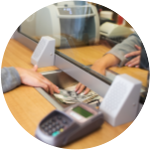
March 2016 A prominent, Michigan-based Native American casino was victimized by a counterfeiter who passed $5k in counterfeit hundred dollar bills at a blackjack table. The dealer’s only prevention was a counterfeit detection pen. Having limited detection capabilities, the bills were marked with the pen, appearing to be legitimate. However, they were later detected as counterfeit only after being processed in the count room using an electronic scanning device. Upon further investigation, the notes were actually bleached $1 bills that were color photocopied with $100 notes – real paper, fake ink. The pen did not catch it because it only deciphers starch content in paper rather than UV colored threads or magnetic inks. This incident alone cost the Casino $5,000 in lost revenue.
THE SOLUTION
If the casino was properly equipped with UV lights or electronic scanning devices, they could have caught the individual before he exited. In most cases, counterfeiters won’t even try if they know proper measures are in place.
SITUATION 2
Cashier accepts $500 in counterfeit bills
February 2015 A counterfeiter claimed to have inherited cash from a late grandfather (currency from 1980s) and wanted to exchange $20 bills for $100s. He used the excuse that all the $20 bills were too bulky for his wallet, and exchanging for larger bills would be easier. The cashier complied, accepted the bills, and marked them with a counterfeit detection pen, and it passed the test. Knowing that the old currency had no UV threads or easily distinguishable characteristics to identify, the teller accepted them. Therefore, with no system in place to detect older currency, the business was stuck with it, costing them $500 in lost revenue.
THE SOLUTION
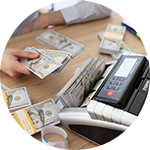
The individual could’ve been apprehended if the cashier had properly utilized up-to-date currency scanning devices to detect the older series notes at the time of the transfer. This also applies to retailers, fast food, or anyone accepting cash.
Federal Notes
Knowing your Bills
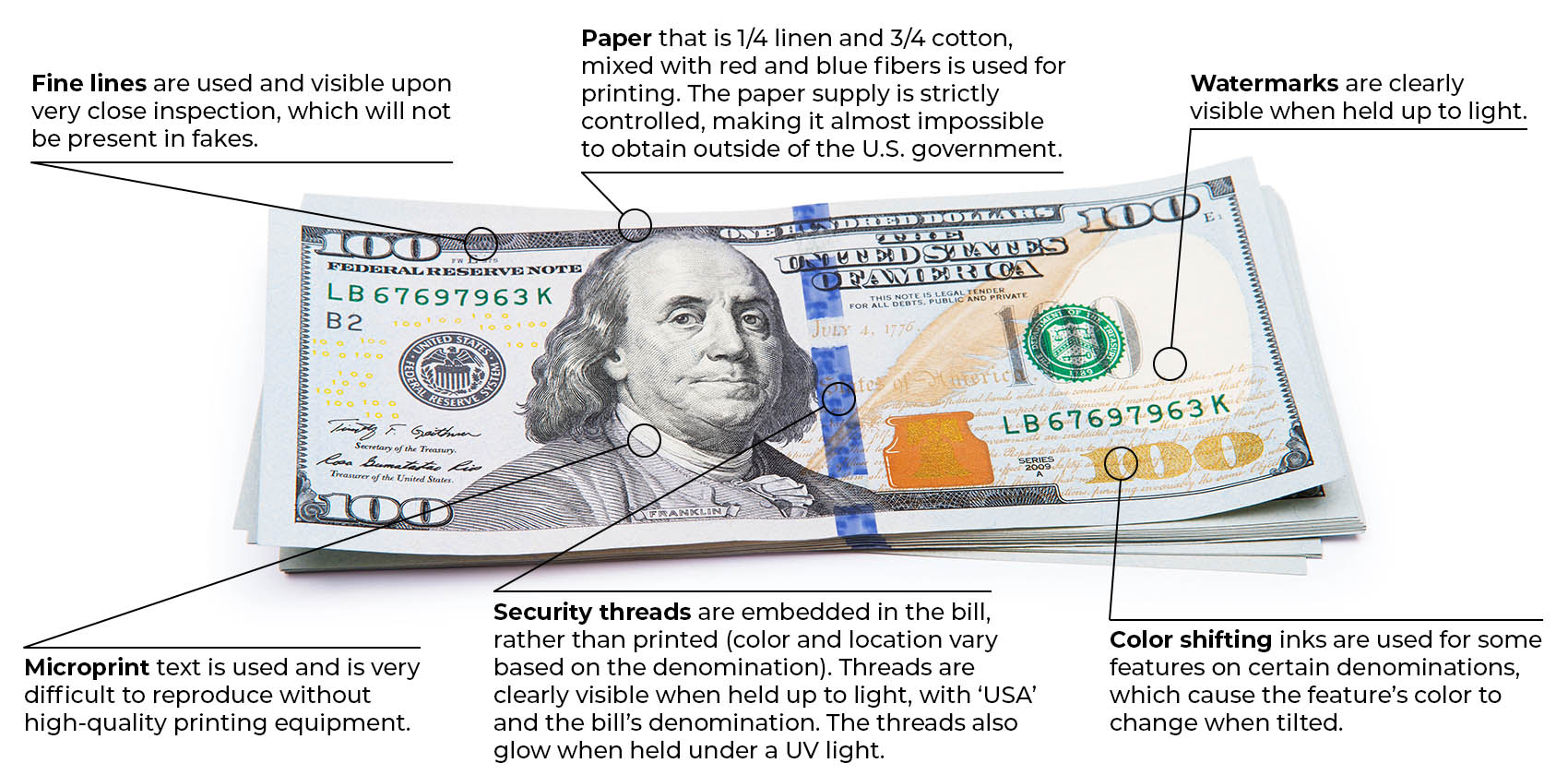
The Secret Service was created in 1865 to suppress counterfeit currency. Back in those days, one third to half of all U.S. currency was counterfeit. Today the agency’s mission has evolved from enforcing counterfeiting laws to safeguarding the payment and financial systems of the United States. Taking a more proactive approach, the Secret Service has implemented advanced technologies and capitalized on partnerships with special task forces. As part of their approach, they encourage business owners, and anyone regularly accepting cash, to educate themselves. A good way to recognize counterfeit currency is knowing the specifics on what’s legitimate. The Secret Service provides valuable information on its website that identifies key aspects of current notes, including the indicators shown below. Although these characteristics make it tough for counterfeiters to duplicate, it’s not entirely preventable. That’s why educating yourself is so vital to knowing what’s real and what isn’t.
Proactive Protection
Counterfeiters prey on vulnerabilities and will not easily put themselves in jeopardy unnecessarily
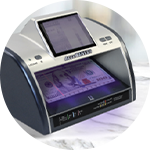
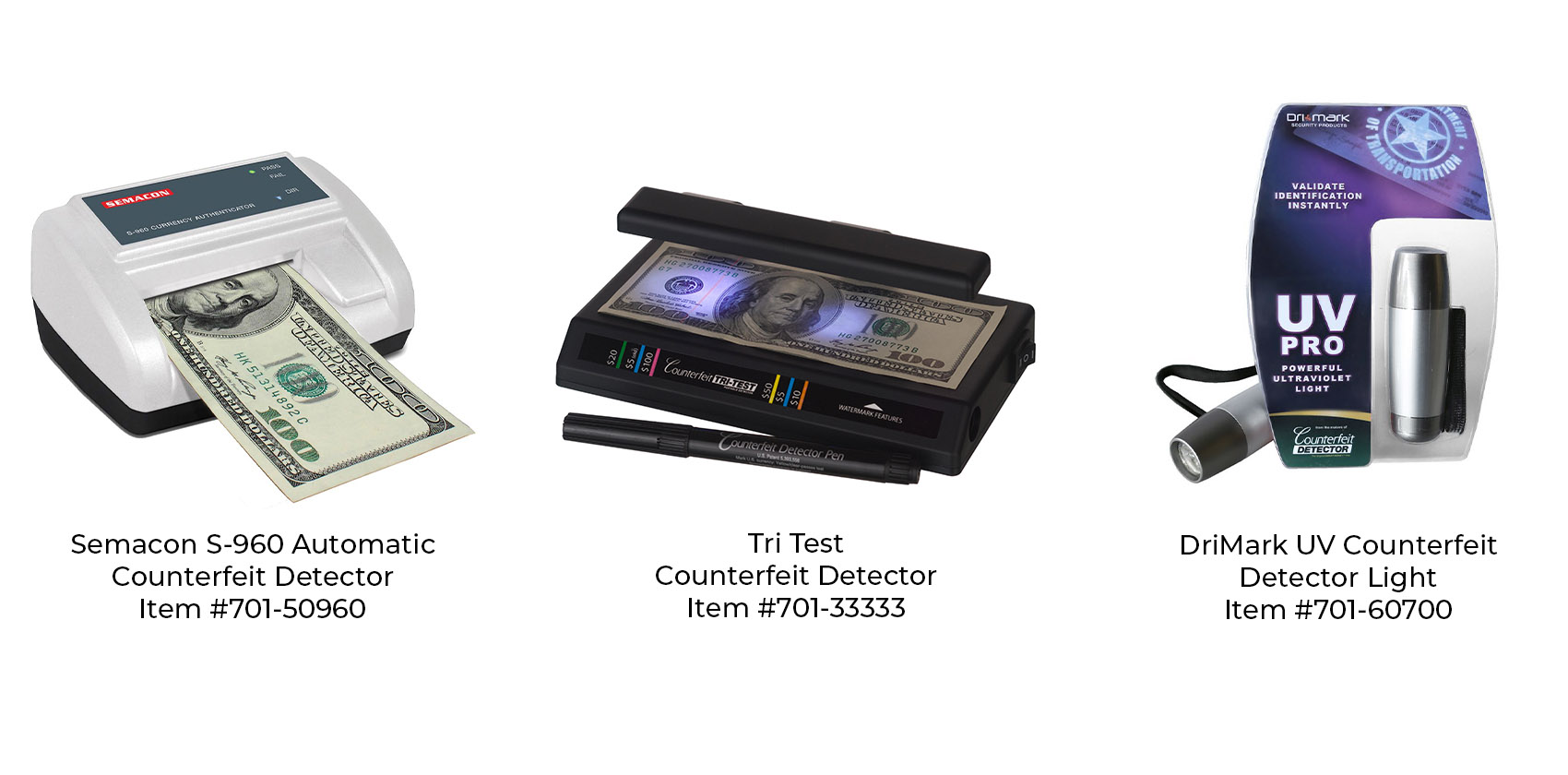
Counterfeiters are actively observing any and all cashiers at retail stores, casinos, vending, groceries and any other human point of sale position. They are looking to see potential challenges they may have to overcome in passing their not-so-funny money. You can ward off these criminals by actively checking suspect currency when first placed in your possession. It may seem like a pain, but it can potentially save you a lot of time, money, and headache. Using the UV Pro Flashlight or Tri-Test system, you can first check the UV colored threads of recently printed notes. If you don’t see colored threads, the S-960 unit is an all encompassing currency checker, which can authenticate old and new notes — even early 20th century currency. This unit thoroughly checks for magnetic, infrared, and UV markings. If a counterfeiter approaches your cashiers and sees them actively using these products, they’ll likely walk away, not wanting to put themselves in jeopardy. Being proactive will help you ward off potential threats before they even get a chance.
About the Author
Rusty Wigal is the CEO of BankSupplies. He is also our expert for counterfeit currency detection. His experience and broad knowledge in the area allows him to provide expert advice and training in the areas of counterfeit detection, the science of currency, and other related topics.
Rusty holds a bachelor’s degree in Computer Science with post graduate work in Mechanical and Electrical Engineering. Before joining BankSupplies in 2003, he was a marketing executive for an engineering software company. Since joining BankSupplies, he has helped develop new markets and product offerings that have expanded the company and added significantly to its growth. He travels extensively on behalf of BankSupplies to educate customers on counterfeit currency awareness and detection products.
Interested in having Rusty visit to train your staff?
Contact BankSupplies at 800.968.7868 or rustyw@banksupplies.com

Related Articles
Explore more resources from the BankSupplies Resource Center.
Can Your Currency Counter Detect Fake Money?
Learn about the counterfeit detection features in modern currency counters and how they safeguard your business.
Read Article
Does a Cheaper Currency Counter Mean Lower Quality?
Understanding price vs. performance in currency counters.
Read Article
Do You Need a Printer with Your Currency Counter?
Benefits of integrated printing for audit trails and records.
Read Article