





































Deposit Slips Explained: Terminology, Ordering, and Common Mistakes
Deposit slips are used by businesses and financial institutions to document and process deposits accurately. This guide explains common deposit slip formats, how numbering works, and what to consider when ordering deposit slips for your organization.
What Is a Deposit Slip?
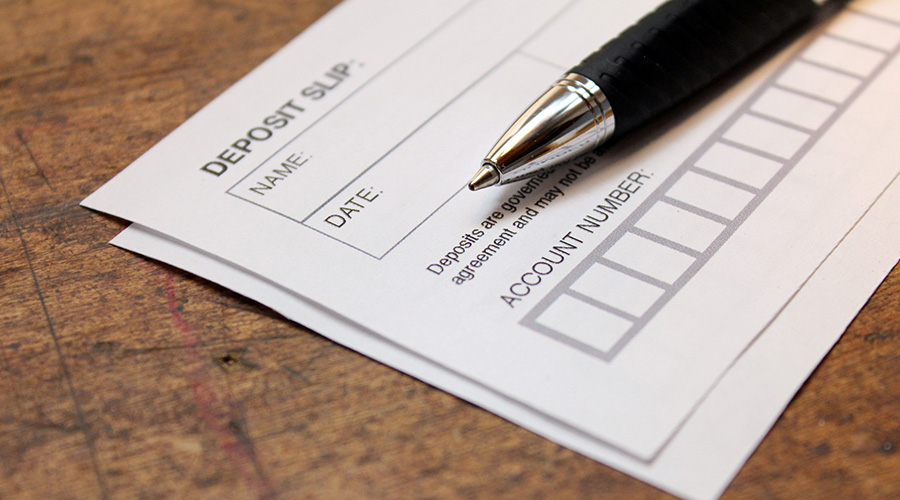
A deposit slip is a document used when depositing cash or checks into a bank account. It provides a record of the transaction and ensures the funds are credited to the correct account. Businesses, financial institutions, and retail operations use deposit slips to document deposits made at bank branches, night drops, or internal processing systems.
Deposit slips typically include fields for the account number, date, currency amounts, check totals, and a final deposit total. Depending on the organization, deposit slips may also include internal reference numbers, routing information, or sequential numbering for tracking purposes.
Deposit slips may appear simple, but the structure and formatting of these forms play a critical role in banking accuracy and record-keeping.
Common Deposit Slip Terminology
When ordering deposit slips, several terms are commonly used to describe the format and configuration of the forms.
Deposits: Refers to the number of transactions that can be recorded on the slip.
Sheets: The total number of physical pages printed for each deposit slip.
Parts: The number of carbonless copies included in each form.
For example, a deposit slip listed as 4 deposits, 3 parts means the form records four individual deposits and produces two carbonless copies in addition to the original.
Booked vs Loose Deposit Slips
Deposit slips are commonly produced in two formats: booked and loose.
Booked deposit slips are bound together into books, often with carbonless copies for record. Businesses that make frequent deposits often prefer this format because the slips stay organized and are easily tracked.
Loose deposit slips are individual forms that are not bound into a book. These are often used for personal banking and convenience.
The choice between booked and loose deposit slips depends on workflow, storage preferences, and how deposits are processed internally.
Sequential Numbering
Many organizations choose to include sequential numbering on deposit slips. This numbering provides an easy way to track deposits, audit transactions, and ensure that no records are missing.
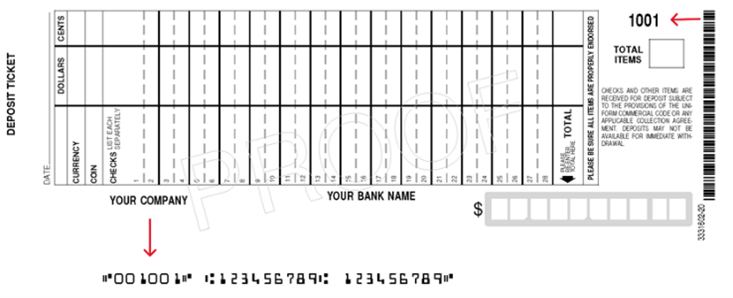
Sequential numbers are especially helpful for businesses with multiple locations or departments making deposits. Accounting teams can quickly verify that all deposits have been processed and reconcile records with bank statements. You can request sequential numbering in either standard Arabic numbering at the end of the ticket or in the MICR line. Below is an example of a deposit slip with both. Standard Arabic Sequential Numbering is in the top right corner.
The MICR Line
The MICR line is the string of numbers printed at the bottom of a deposit slip using magnetic ink. MICR stands for Magnetic Ink Character Recognition.
This line typically includes the bank routing number and the account number associated with the deposit. When processed by banking equipment, the magnetic ink allows machines to read the information quickly and accurately and works well as an anti-fraud measure.
Because the MICR line must meet strict banking standards, its placement and formatting cannot be changed without approval.
MICR Line Breakdown
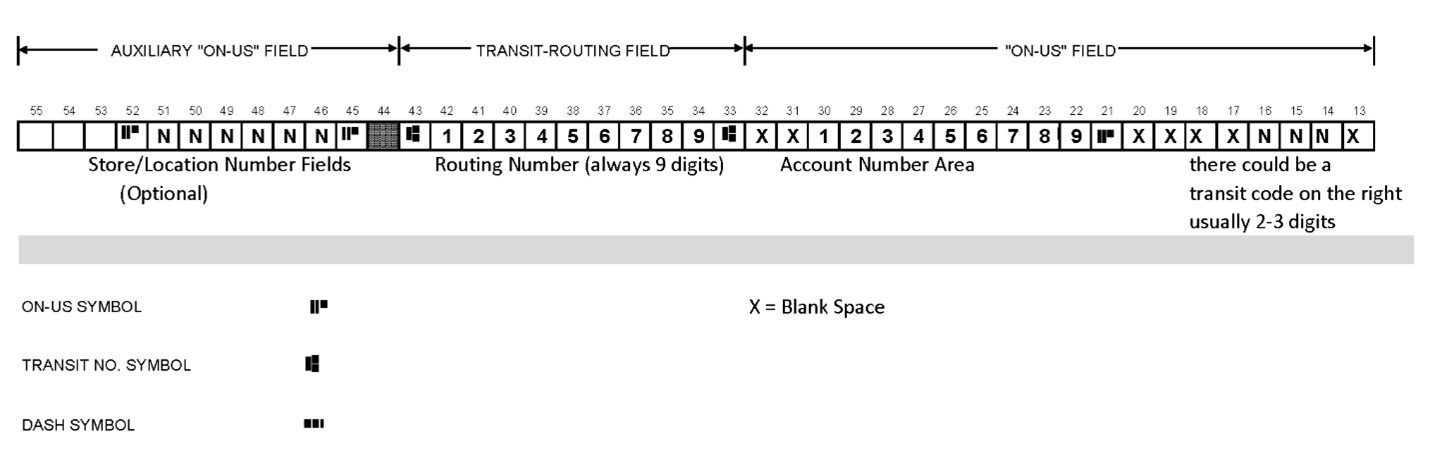
The Auxiliary “On-Us” Field: These are optional and only used on commercial checks. They appear on the farthest left side of the MICR line. This information is determined by the financial institution and can contain information specific to the account. The above example uses “Store/Location Number.” This field can also be used to store check serial numbers and other information such as use of treasury or risk management services. A check that contains an Auxiliary “On-Us” field has to be longer than 6 inches.
Routing Number (Transit Routing Field): This is a 9-digit code identifying the financial institution associated with the account.
On-Us Field: This differs from the optional Auxiliary On-Us field as it will always appear on the check or deposit slip and contains necessary information such as Account Numbers and Transit Codes.
MICR Line Symbols: These are necessary for the scanner to differentiate between different sections of the MICR line. The fonts used to create MICR lines use letters to represent the symbols.
Consecutive Numbering in the MICR Line: If the document has consecutive numbering in the MICR line it will appear on the far right of the MICR line.
Common Deposit Slip Mistakes
One of the most common mistakes organizations make is ordering deposit slips without fully understanding the required format.
Issues can occur when the wrong number of deposit lines is selected, when carbonless copies are not included, or when the MICR line does not match the bank’s requirements.
Before placing an order, it is important to verify:
• Number of deposit lines needed
• Number of carbonless copies required
• Booked vs loose format
• Correct routing and account numbers
Custom Deposit Slips
Many businesses require deposit slips that include additional fields or branding elements. Custom deposit slips can include company logos, internal tracking numbers, department fields, or specific layouts designed to match accounting procedures.
Custom forms allow organizations to streamline deposit processes while maintaining consistent record-keeping across departments.
Working with a supplier experienced in banking forms, such as BankSupplies, ensures the deposit slips meet financial industry standards while accommodating the specific needs of the organization.
Deposit Slip Product Reference
This table outlines available deposit slip formats, configurations, and compatible layouts to help you quickly identify the right option for your operation. You can see all of our available products in the Deposit Slips category.
| Item Name | BSI SKU | Key Features | Order |
|---|---|---|---|
| Deposit Slips - 4 Line w/ Currency Summary | 457-10101 | 4-Line Check Entry, 1-Line Currency, 1-Line Coin, Horizontally Aligned | View |
| Deposit Slips - 9 Line with Currency Summary | 457-12001 | 9-Line Check Entry, Cash Breakout, Total Cash, 1-Line Coin | View |
| Deposit Slips - 12 Line w/ Barcode | 457-81001 | 12-Line Check Entry, 1-Line Currency, 1-Line Coin, Barcode | View |
| Deposit Slips - 15 Line | 457-15101 | 15-Line Check Entry, 1-Line Currency, 1-Line Coin | View |
| Deposit Slips - 17 Line | 457-22001 | 17-Line Check Entry, 1-Line Currency, 1-Line Coin | View |
| Deposit Slips - 17 Line w/ Barcode | 457-71001 | 17-Line Check Entry, 1-Line Currency, 1-Line Coin, Barcode | View |
| Deposit Slips - 18 Line w/ Barcode | 457-91001 | 18-Line Check Entry, Cash Returned, Barcode | View |
| Deposit Slips - 19 Line | 457-92101 | 19-Line Check Entry, Total Cash, Front Side Total | View |
| Deposit Slips - 21 Line | 457-11101 | 21-Line Check Entry, 1-Line Currency, 1-Line Coin | View |
| Deposit Slips - 23 Line | 457-32001 | 23-Line Check Entry, 1-Line Currency, 1-Line Coin | View |
| Deposit Slips - 28 Line - Check Entry | 457-45101 | 28-Line, Bank/Customer Name Side Aligned, Bag # Line | View |
| Deposit Slips - 28 Line with Total Cash Line | 457-D6001-2 | 28-Line, Total Cash, Bank Name Above Total | View |
| Deposit Slips - 28 Line - Customer/Bank on Side | 457-42001 | 28-Line, Customer/Bank Name Side Layout | View |
| Booked Deposit Slips - 28 Line - Customer/Bank at Top | 457-61001 | 28-Line, Top-Aligned Customer/Bank Name | View |
| Deposit Slips - 32 Line | 457-52001 | 32-Line Check Entry, 1-Line Currency, 1-Line Coin | View |
| Deposit Slips - Design 7 | 457-00003-07 | 26-Line, Image Processing Compatible, Duplicate/Triplicate | View |
| Deposit Slips - Design 10 | 457-00003-10 | 28-Line, Image Processing Compatible | View |
| Deposit Slips - Design 12 | 457-00003-12 | 22-Line, Cash Breakdown, Image Processing Compatible | View |
| Laser Deposit Slips - Peachtree | 457-LASER-PT-1 | Peachtree Compatible, Up to 5 Imprint Lines | View |
| Laser Deposit Slips - QuickBooks | 457-LASER-QB | QuickBooks Compatible, Up to 19 Deposit Lines | View |
Frequently Asked Questions
How many deposit slips are in a book?
Deposits slips can come either booked or loose. Loose comes 200 sheets to a box. If they’re booked, they’re bound together in a single book containing 100 sheets and a cover. The total number of books in a box is going to depend on how many parts the deposit has. To determine the number of books, use the formula below:
1-Part: 100 Deposits per Book
2-Part: 50 Deposits + 50 Carbonless Copies per Book
3-Part: 33 Deposits + 66 Carbonless Copies per Book
4-Part: 25 Deposits + 75 Carbonless Copies per Book
Total Books = Unit of Measure/Number of Deposits
(i.e., Box of 200, 2-Part Deposit Slips is Box of 200/50 Deposits = 4 Books)
What does a 3-part deposit slip mean?
A 3-part deposit slip includes the original form plus two carbonless copies, allowing multiple records of the same deposit.
Why do deposit slips use carbonless paper?
Carbonless paper automatically creates duplicate copies of the deposit information without requiring separate writing.
Does the unit of measure include the carbonless copies?
Our default units of measure are boxes of 200, 400, and 800. These are the total number of deposits being ordered and NOT the total number of sheets. For example, a Box of 200 will contain 200 deposits regardless of the number of parts it has. So, a box of 200 of a 4-Part slip will be 800 sheets, but only 200 deposits.
Deposits = Unit of Measure
Sheets = Unit of Measure x Number of Parts
Can deposit slips be customized?
Yes. Businesses often customize deposit slips with company logos, internal tracking numbers, or department fields while maintaining the required banking standards.
What is the MICR line on a deposit slip?
The MICR line contains magnetic ink characters used by banks to automatically read routing and account numbers during processing.
Related Articles
Explore more resources from the BankSupplies Resource Center.

Can Your Currency Counter Detect Fake Money?
Learn about the counterfeit detection features in modern currency counters and how they safeguard your business.
Read Article
Your Guide to IRD Checks for Banks, Retail & Business
As check processing continues to evolve in today & digital banking environment, businesses need secure and efficient ways to manage electronic deposits and recordkeeping.
Read Article
Banks and Credit Unions Supplies List
Comprehensive catalog of essential supplies and equipment for banking operations.
View PDF